Product Engineer Onboarding
2-Week Program · March 2026

The Industry Changed

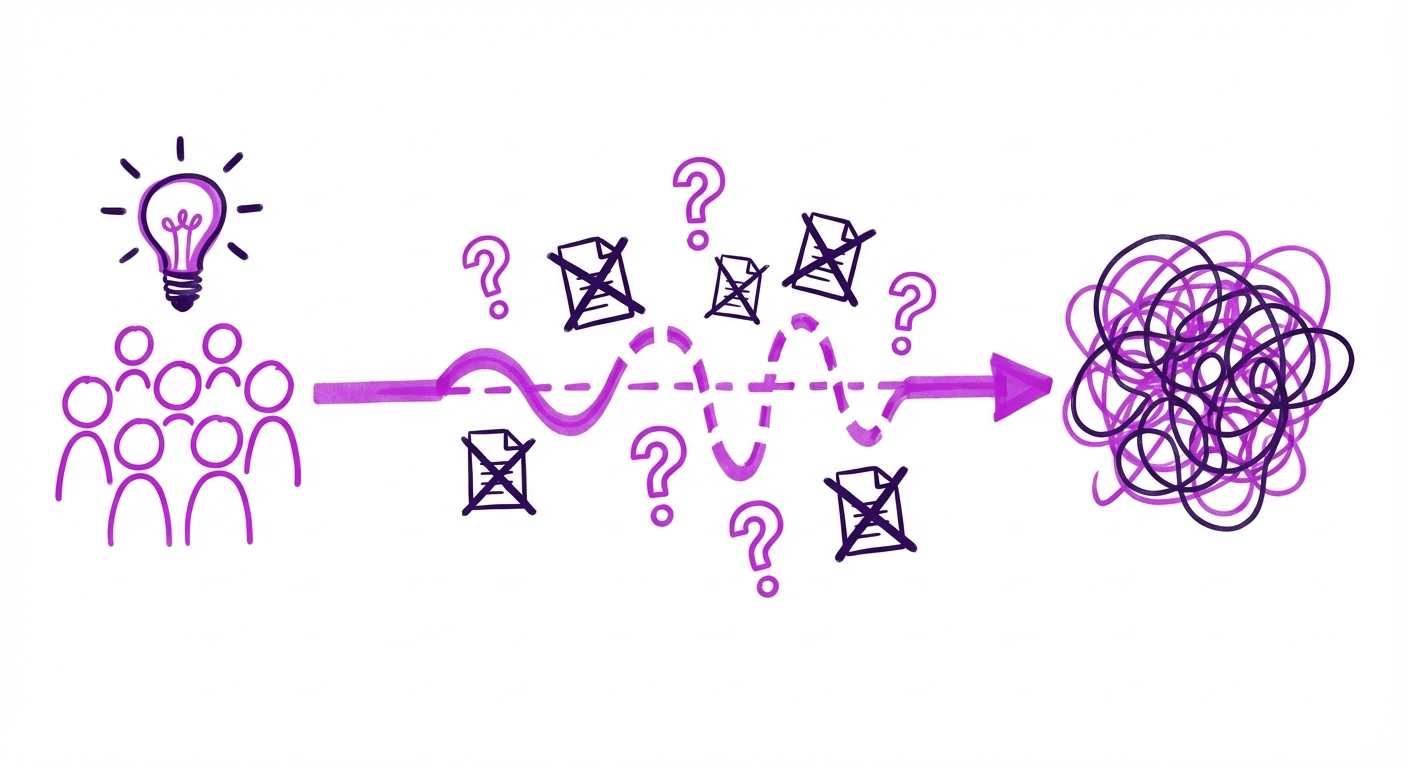
  • Most agencies sell developer hours. 6 people, 6 months, hundreds of thousands of dollars.
  • But 80% of the value was delivered in the first 2 weeks — when someone understood the problem.
  • The remaining months? A byproduct of understanding. Traditionally it takes a long time — with context drifting along the way.
  • Sometimes the understanding is clear, but the output doesn't match the original vision.
  • Or worse — the original vision is mistaken, even though the output matches it perfectly.
The old agency model — context drifting over time

The Work That Matters

  • AI compressed the building. The understanding remains human.
  • CRUD apps, dashboards, REST APIs — the cost is approaching zero. What remains expensive: clarity.
  • Writing blueprints is unglamorous work. Sitting in meetings with users is painful. Nobody posts about it on LinkedIn.
  • But this is the work that provides the most value. Understanding. Articulation of that understanding. And the capability to provide solutions based on it.
  • That's the job. The rest is execution.
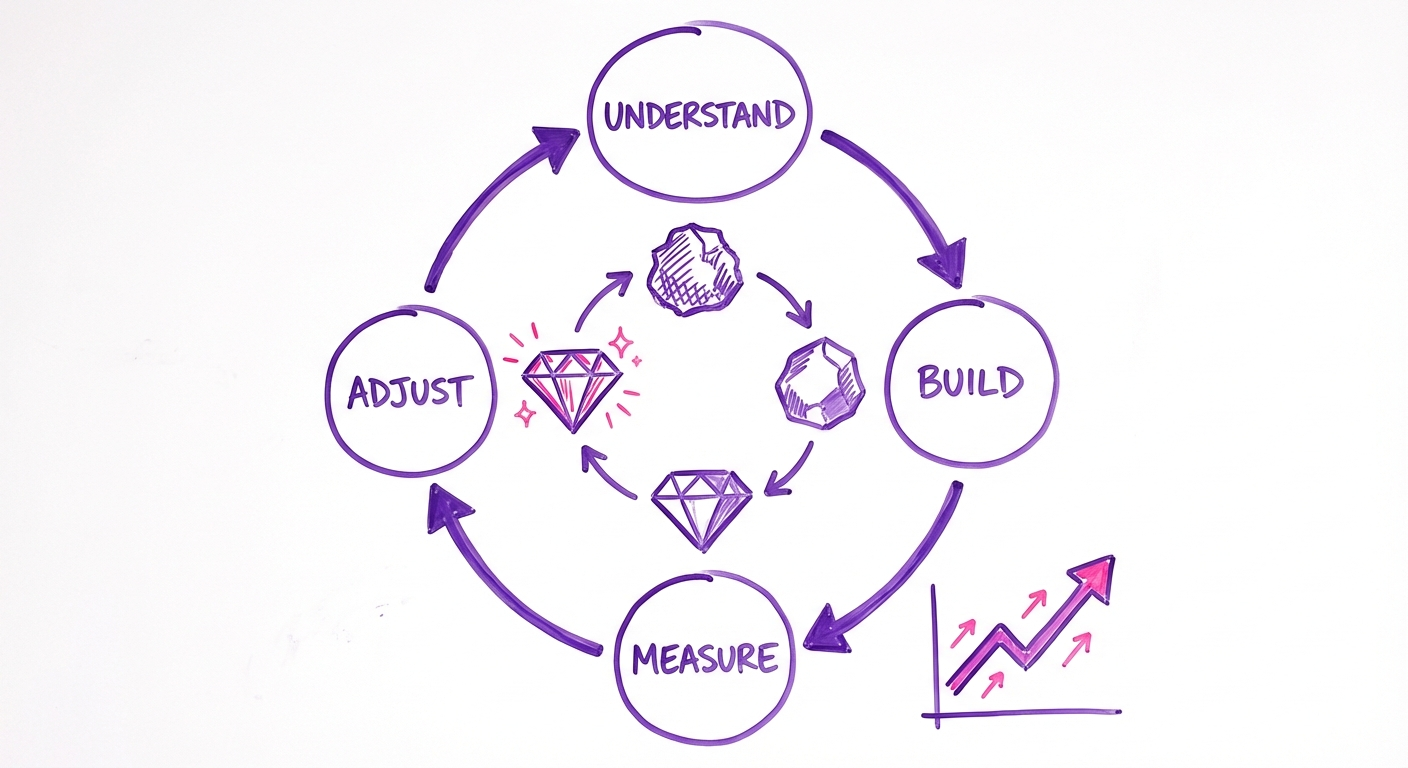
  • But we don't stop at understanding once.
  • We set up the platform so it sharpens understanding over time. Continuous measurement. Constant small adjustments that nudge the product into better shape — week after week, release after release.
  • The goal isn't a perfect launch. It's a system that learns.
Continuous feedback loop — understand, build, measure, adjust

Software Engineer → Product Engineer

Software Engineer
Builds what the spec says
Measures sprint velocity
Owns code quality
Thinks in features
"How do we build it?"
Product Engineer
Ensures we build the right thing
Measures business impact
Owns the outcome
Thinks in problems
"Should we build it?"

A Product Engineer's Week

Monday
Client discovery call — Listen, probe, map stakeholders. Understand the business before the backlog.
Tuesday
Write specifications — Turn yesterday's insights into precise, buildable specs.
Wednesday
Build prototype — AI-first. Codex, Claude Code. Spec to working software in hours.
Thursday
User testing — Watch 3 people use what you built. Don't explain. Just observe.
Friday
Iterate or pivot — What did you learn? What stays, what dies, what changes?

Five days. Full cycle. Understanding → Building → Validating.

The Five Disciplines

  1. Listen like a journalist — The spec is in the frustration, not the feature request.
  2. Write with precision — If an AI can't build from your description, it isn't clear enough.
  3. Go deep in one industry — Broad technical knowledge, deep domain expertise. The T-shape.
  4. Measure what matters — Activity is not impact. Shipping is not solving.
  5. Know when to say no — The most valuable thing you can tell a client is "you don't need this."

The Synetica 2B2G Pipeline

graph LR
  BP["🔍 Blueprint\n2 weeks"] --> BB["🔨 Build &\nBenchmark\n6 weeks"] --> GTM["🚀 Go-to-\nMarket"] --> GR["📈 Growth"]

  style BP fill:#BF16F2,stroke:#200654,stroke-width:2px,color:#fff,font-weight:bold
  style BB fill:#E2E9FF,stroke:#BF16F2,stroke-width:2px,color:#200654
  style GTM fill:#E2E9FF,stroke:#DB1363,stroke-width:2px,color:#200654
  style GR fill:#E2E9FF,stroke:#DB1363,stroke-width:2px,color:#200654
        

This onboarding covers the Blueprint phase — the most critical 2 weeks.

Two Weeks. Two Phases.

graph LR
  subgraph W1["WEEK 1 · UNLEARN"]
    A[Observe] --> B[Question] --> C[Listen] --> D[Write] --> E[Prototype]
  end
  subgraph W2["WEEK 2 · REBUILD"]
    F[Discover] --> G[Research] --> H[Build] --> I[Test] --> J[Present]
  end
  E --> F

  style W1 fill:#E2E9FF,stroke:#BF16F2,stroke-width:2px,color:#200654
  style W2 fill:#E2E9FF,stroke:#DB1363,stroke-width:2px,color:#200654
  style A fill:#fff,stroke:#BF16F2,color:#200654
  style B fill:#fff,stroke:#BF16F2,color:#200654
  style C fill:#fff,stroke:#BF16F2,color:#200654
  style D fill:#fff,stroke:#BF16F2,color:#200654
  style E fill:#fff,stroke:#BF16F2,color:#200654
  style F fill:#fff,stroke:#DB1363,color:#200654
  style G fill:#fff,stroke:#DB1363,color:#200654
  style H fill:#fff,stroke:#DB1363,color:#200654
  style I fill:#fff,stroke:#DB1363,color:#200654
  style J fill:#fff,stroke:#DB1363,color:#200654
        

Week 1 strips away assumptions. Week 2 rebuilds from first principles.
How We Actually Work

The HokBen Blueprint — A Real Example

1
Stakeholder Interviews
Structured questions across Business Vision, Target Users, Technical Architecture, Operations. Not "what do you want?" but "What happens when a new order comes in? Show me. What breaks?"
2
Digital Survey
Push notification to 300–500 real HokBen app users. 3–5 minute survey. Rp 20,000 voucher incentive. Measured: order frequency, satisfaction (1–5), pain points, feature usage.
3
In-Store Interviews
30–50 face-to-face interviews during lunch (11:30–13:30) and dinner (18:00–20:00). Segmented: Working Parents 30%, Gen-Z Explorers 20–25%, Regular Diners 20–25%, Non-App Users 20–25%. Figma prototype testing on-site.
4
Persona Development
"Rina — Working Parent, 35, Jakarta. Orders 3–4×/month, avg spend Rp 90–150K. Goal: complete family order in under 3 minutes." Data-driven, not imagined.
5
Blueprint Deliverables
Business context, market research, product definition (epics, user journeys, sitemaps, wireframes), full technical specification (tech stack, API design, database schema, security, scaling, testing).

Tools: Maze · Google Forms · Figma · Mermaid
The point: Discovery → Research → Validate → Specify → Build. This is the job.

Week 1 — Unlearn

Day 1
Mindset Reset
Read "The Code Is Not the Point Anymore." Understand Synetica OS and 2B2G. Discuss: why do Software Engineers need to change?
Day 2
Problem Discovery
Learn Jobs-to-be-Done. Practice stakeholder mapping with the HokBen interview template. Write your own interview questions for a practice project.
Day 3
Shadow & Listen
Sit in a real client call (HokBen daily sync or similar). Take notes. Debrief: "What did they say? What did they mean? What didn't they say?"
Day 4
Specification
Take a real problem and write a spec. It must be clear enough that an AI (Codex/Claude) can build from it. Peer review: swap specs and try to build from each other's.
Day 5
AI-First Build Day
Use Codex CLI and Claude Code. Build a working prototype from your spec. 4-hour challenge. No hand-coding commodity work.

Week 2 — Rebuild

Day 6
Mini-Discovery Workshop
Pick a real internal problem or client need. Create stakeholder map, interview questions, survey design. Run the workshop yourself.
Day 7
Research Design
Design a user research plan. Create a digital survey (like the HokBen one). Set up a Maze prototype test. Write an in-store interview guide.
Day 8
Full Build Day
AI tools, full day. Prototype must be testable by real users. Not a demo — something people can actually try.
Day 9
Test & Decide
Run actual user tests with 3–5 people. Use Maze or manual testing. Analyze results. Decide: what to keep, what to kill, what to change.
Day 10
Capstone
Present to panel (Ganis, Rijal, Dion): Problem → Research → Insights → Spec → Build → Test Results → Recommendations.

What We Measure

Not this

Lines of code. Story points. Hours logged. Sprint velocity.

Problem Articulation
Can you explain the client's real problem in 1 paragraph without jargon?
Research Design
Can you design a survey + interview plan that yields actionable data?
Specification Quality
Can an AI build from your spec without asking clarifying questions?
Prototype Speed
Can you go from spec to working prototype in under 4 hours?
Stakeholder Communication
Can you present findings to non-technical decision makers?
Judgment
Can you identify what should NOT be built?
Graduation: Complete capstone. Then join a real Synetica project as Product Engineer.
The best engineers don't write the most code.
They prevent the most waste.
SYNETICA • Move with evidence.